

WHAT‘S HAPPENING
News & Events
Meet the Adelaide Studios Tenant: Karu-Karu
22 June 2026
The SAFC’s Adelaide Studios isn’t just a screen production facility, it’s a creative hub that’s home to dozens of South Australian screen businesses and screen practitioners. In this ongoing series of SAFC interview profiles, we invite you to meet the tenants and get to know their work.
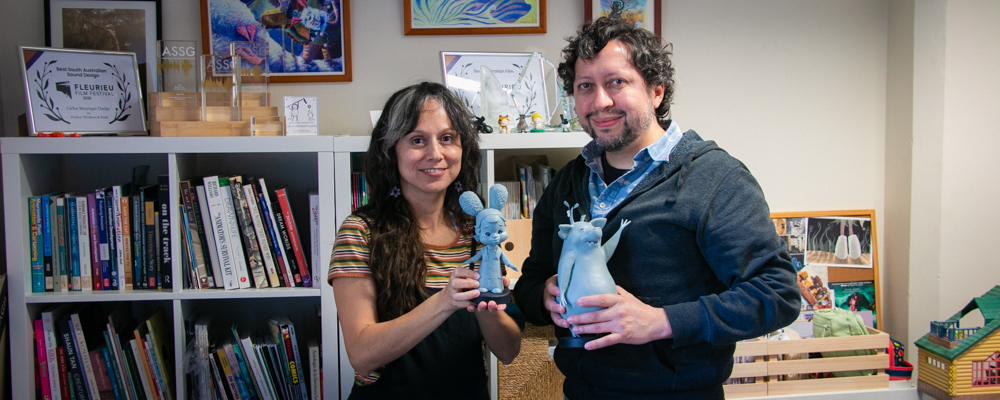
Ana María Méndez Salgado and Carlos Manrique Clavijo are the creative partners behind the animation production company Karu-Karu. They’re also partners in life.
The pair met at university in Colombia. Ana was studying visual arts, and Carlos was studying music with a major in sound engineering.
Ana says that she’d always wanted to do animation, so for her graduation project, she decided to create one. The story was hers, but the project was a collaboration with other artists and practitioners.
“It was a lot of work,” she says. “A lot of drawings.” And of course, she needed someone to do sound.
Carlos already knew who Ana was, and was “very captured” by her work, so he jumped at the opportunity to help. And they’ve been creating animations together ever since.
“It’s very special,” Carlos says. “How often do you get a chance to work with the love of your life?”
A semester exchange to La Trobe University first planted the idea of living in Australia in their minds, and in 2007 they made the move to Adelaide. While Ana and Carlos have both held a variety of industry and academic roles, Carlos says they’d always hoped to get back to creating their own projects.
“Once you taste making animation for the first time, you get hooked on it. You want to do that for the rest of your life.”
Karu-Karu was founded in 2013. Initially, they were based out of Adelaide’s emerging screen practitioner hub and cinema The Mercury, in a space that was provided as in-kind support for a project they were working on. Ana and Carlos found they loved being based out of a creative hub.
Ana says that they “loved how involved we got with other creatives – the environment, the people, it was just very inspiring beautiful work.”
As they got more immersed in South Australia’s screen sector community, Ana and Carlos got to know producer Lara Damiani, operating Think Films from Adelaide Studios. When the time came for Karu-Karu to find a new home, Lara kindly offered up a desk in her office until they eventually got a space of their own, just down the hallway. Fast forward to today and they’re still neighbours at Adelaide Studios, and enjoy collaborating on projects.
Ana and Carlos speak very highly of their fellow tenants, saying there’s “probably only a few people in the building we haven’t collaborated with, and it’s not because we don’t want to – it’s because life is busy.”
Ana says there is a real sense of camaraderie between tenants because “we’re in the same boat. When they see opportunities, they tell us; when we see them, we tell them.”
“People are generous, and because of that generosity, it feels like a community.”
Ana loves that the South Australian screen industry as a whole is so driven by a desire to establish their own voice.
“My students don’t just want to be part of someone else’s project; they want to create their own stories,” she says.
Carlos references a saying Australian animation artist Deane Taylor shared with fellow animation producer Luke Jurevicius: “It’s not only about ‘less is more,’ but about doing more with less.”
“I think that’s very South Australian,” Carlos says.
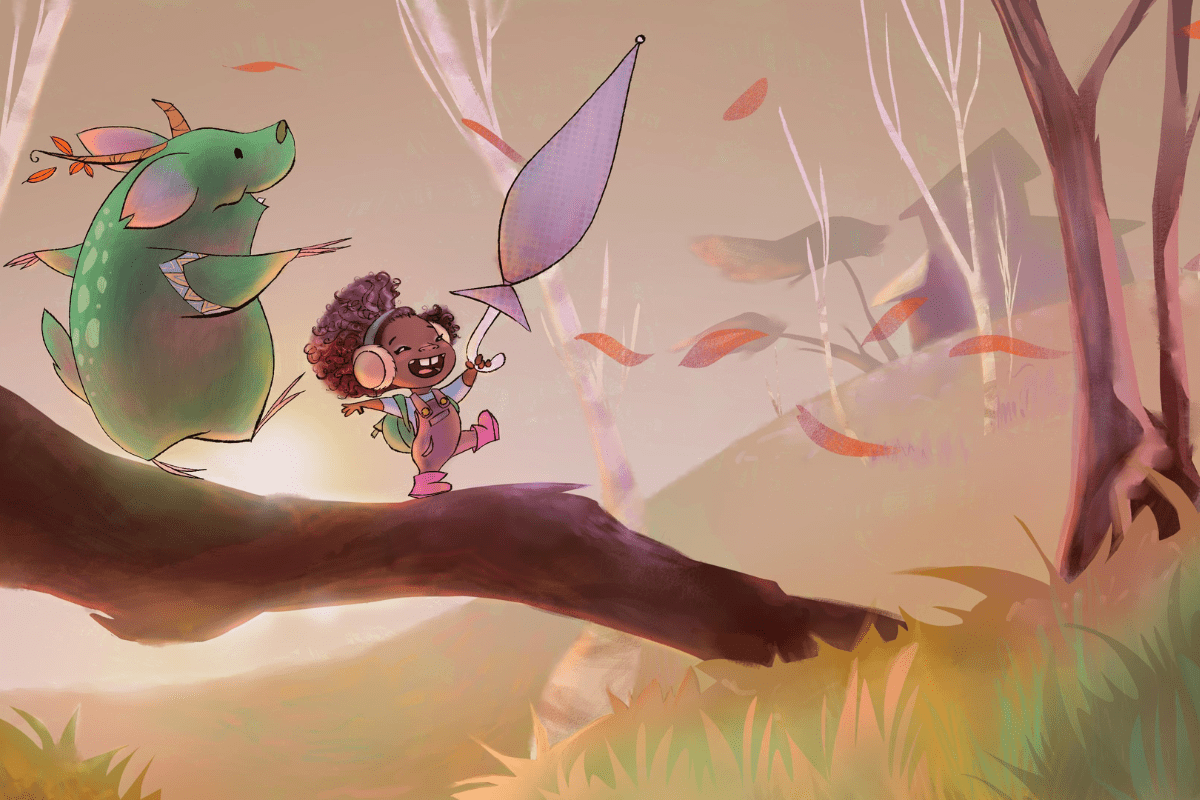
Karu-Karu’s award-winning animated short film Wishes: Windows & Nests was inspired by a traffic jam, nearly a decade ago. Ana and Carlos had been driving somewhere in a hurry and almost collided with a speeding motorcyclist.
“He got really angry with the world and everyone around them, just screaming and swearing,” Carlos says.
Rather than stoop to the motorcyclist’s level, they decided to offer him grace: “He must be having really big issues, under a lot of stress.”
Ana says they thought it would be “beautiful” to wish him good things. “Like, I hope your day goes well, and whatever is troubling you gets solved.”
This seed of an idea became Wishes, which eventually grew into a project aimed at children, inspired by their own daughter.
Karu-Karu received development funding from Screen Australia, the SAFC and Adelaide Film Festival and produced an animated short – a pilot episode for a future Wishes series – which premiered at AFF 2024.
The short has since been selected for festivals all over the world, including Sitges Film Festival, Zlín International Film Festival for Children and Youth, St Kilda Film Festival and Flickerfest, and won Short Film Production of the Year at the 2025 Screen Producers Australia (SPA) Awards.
Wishes also offered a special opportunity for collaboration with other Adelaide Studios tenants, this time with Ruth Estelle and Pete Monaghan of Word Ninjas who served as story editors.
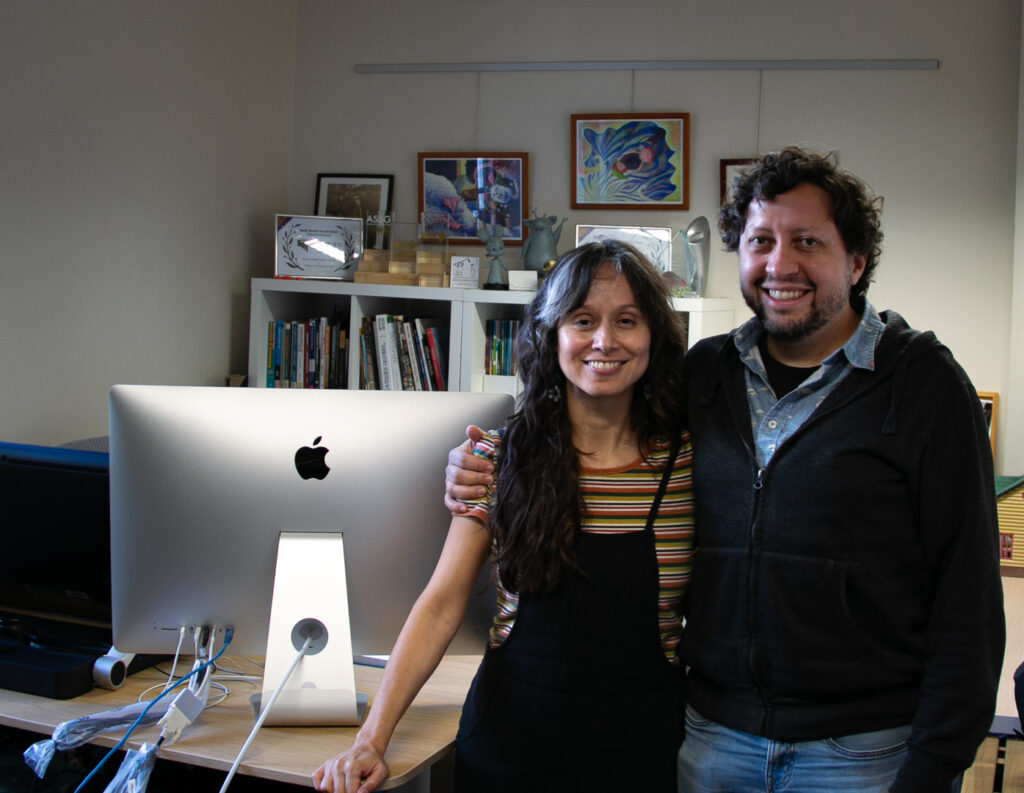
When asked what they love most about working in the screen industry, Carlos says he appreciates the struggle of being a creative. Whether it’s trying to find a character or solve a story problem, he loves both being able to find the solution and “growing through the struggle.”
For Ana, it’s being able to explore the hard questions.
“It lets you figure out who you are, and work out spiritual problems, or identity problems.”
She loves it when audiences connect with these ideas, and as a migrant and neurodivergent person, she particularly enjoys creating something that a diverse audience might relate to.
As migrants, one of the biggest challenges they’ve both faced in their careers is having to reinvent themselves several times. When they made the move from Colombia to Australia, they found they had to build up their profile from scratch once again, despite having significant experience back at home.
“It’s that lack of opportunity when nobody knows you,” Carlos says.
Ana explains that as neurodivergent people, building connections is made more challenging by the inaccessible nature of traditional networking events – “very noisy, very busy.”
Despite these additional hurdles, they’ve both built meaningful relationships in the industry and consider themselves lucky to have met so many “beautiful people” in the industry who have supported them on their journey.
For aspiring screen creatives, they emphasise the need for attention to detail, a willingness to learn, and a love for the craft – because “it’s not an easy path.”
On top of having a lot of love for other screen practitioners, Ana and Carlos are big fans of South Australian film and TV. Ana names some of her favourite productions: Scarygirl,The Adventures of Figaro Pho, Beep and Mort, Deafinition.
Carlos says if he had to choose one, it would be Scott Hicks’ Shine. He says he watched it “long before” he ever dreamed of living in Australia.
“I was in high school, aspiring to study music, and that film really touched my soul. And so, when we first came to Adelaide Studios and walked through the corridors, it was surreal. Like – you’re walking in a place where this film was shot.”
“I’d love to go back and tell my 15-year-old self – you’re actually going to be working in that place!”
With support from the SAFC’s Export Market Travel Fund, Ana and Carlos are now headed to the Annecy International Animation Film Market (Mifa) as part of the Ausfilm Australian Animation delegation with the aim of raising interest in a Wishes series.
They already have a lot of exciting meetings lined up but are also looking forward to making organic connections at networking events. As well as pitching their slate and getting Karu-Karu’s name out there, Ana and Carlos are also looking forward to flying the flag for South Australia.
“We’ve been here 20 years,” Carlos says.
Ana adds: “It feels like part of who we are.”
By Alex Knopoff